
Guardian Home Program: How It Works, the Contract and the Records
By Kenny SchultzLast reviewed
A guardian home program places one of a breeder's breeding dogs with a local family as their pet, while the breeder keeps ownership and breeding rights under a written contract. The dog comes back for health testing, breedings and whelping. After the agreed litters, the dog is spayed or neutered and full ownership passes to the family.
Key takeaways
- Write the exact number of litters, the age she retires by, and who pays for what into the guardian contract, not "as agreed".
- Choose guardian families within an easy drive, since a female in heat may need several trips to you in a week or two.
- Set the family's contact type to Guardian Family before you make them the dog's owner, so BreederBuddy records a guardian home, not a sale.
- Log every heat the guardian family reports, not just the ones you breed, so her next-heat estimate keeps getting better.
- Apply what you spend on a guardian dog to her record, and log the miles on each drive, so you know what she really costs.
A guardian home program places one of your breeding dogs with a local family who keeps her as their pet, while you keep ownership and breeding rights under a written contract. She comes back to you for health testing, breedings and whelping, and when her agreed litters are done she's spayed and the family becomes her owner.
Your breeding dogs live as family pets, and your program can grow past what your own house holds. The catch is that a dog you need on a schedule lives somewhere else.
Below: how it works, choosing a family, the contract, the records, then BreederBuddy step by step.
How a guardian home program works
A guardian dog splits her life in two: home life with the family, breeding life with you. For a female, it runs in five stages.
- Placement. Some programs place a guardian puppy at go-home age; others place a young adult they've already evaluated.
- Health testing. OFA won't certify normal hips or elbows before two years of age, though preliminary hip screenings are available from four months. A puppy placed at eight weeks may not pass, so the contract says what happens then.
- Heats and breedings. The family tells you the day her heat starts. For the heat you breed, she comes in for progesterone timing (often a draw every two or three days, as your vet advises) and then the breeding.
- Whelping. She usually moves to your house shortly before her due date and stays until the puppies are weaned.
- Retirement. After her last contracted litter she's spayed, usually at the breeder's expense, and ownership and registration pass to the family.
In return, the family usually pays little or nothing for the dog, and some programs also pay them for each litter.
A male works the same way: breeding and collection rights for an agreed period, then a neuter. If he also stands at stud, see stud dog management.
The trade-off is control: another household has to feed her as you asked, notice her heat, keep her away from intact dogs and get her to you on time.
Choosing a guardian family
The right guardian family lives close, follows instructions and is at peace with sharing their dog. Screen for these:
- Distance. A female in heat may need several trips to you in a week or two, often on short notice. Pick a radius, such as an hour's drive.
- No intact dog of the opposite sex at home, and a plan for the neighbor's.
- A fenced yard and someone home enough to spot the first signs of heat.
- Stable housing. Renters need the landlord's OK; a family planning a move soon is a risk.
- Comfort with time apart. She'll be gone for weeks around each litter. Tell the kids up front.
- Reliable contact. Ask how they'd tell you her heat started, and how fast.
Run a guardian application with its own questions, visit the home, and let the family read the contract before they commit.
What a guardian home contract covers
A guardian home contract settles ownership, money, the litters and what happens when life changes, before the dog leaves your house. Here's what each term should settle, and whether our starter Guardian Home Agreement template covers it:
| Term | What to settle | In the starter agreement |
|---|---|---|
| Ownership | You keep ownership and registration until the terms are met | Yes |
| Care and costs | Family: food, a safe indoor home, vaccinations, routine vet care. You: health testing, breeding, pregnancy, whelping | Yes |
| Litters | The exact number, and the age she retires by | Leaves the number to you |
| Heat reports | The family tells you promptly when a heat starts | Yes |
| Time with you | When she comes to you, and for how long | Says she may stay with you around whelping |
| Health testing | Testing before breeding, and early release if she fails | Yes |
| Transport | Who drives, and who pays for the miles | No |
| Completion | Spay or neuter at your cost, then ownership and registration to the family, free | Yes |
| Rehoming | No selling or rehoming; you may reclaim her if her care slips or they can't keep her | Yes |
| Moving or buyout | A move out of range, or ending early for an agreed price | No |
Decide the hard cases now: a move, a breakup, an accidental breeding at home, or a vet advising early retirement after a hard whelping.
It's not the spay/neuter contract you give pet buyers: a guardian dog is meant to be bred, and her spay comes at the end, on your bill.
This is general information, not legal advice. Law varies by state, and since you stay her legal owner while she lives elsewhere, ask an attorney about your liability for a dog in someone else's home, and have them review your agreement.
Records to keep for a dog who lives elsewhere
When a breeding dog lives elsewhere, your records are the only place her whole history comes together:
| What to keep | Where in BreederBuddy |
|---|---|
| Who has her, and how to reach them the day her heat starts | A Guardian Family contact, set as her Owner |
| The signed agreement | The family's Contract Requests |
| Every heat start date, so you can predict the next | Her Heat Cycles tab |
| Progesterone results and breedings | The heat cycle they belong to |
| Vet visits and health testing (get copies from her vet) | Her Health and Certifications tabs |
| Drop-off and pick-up dates | A calendar event linked to her |
| What you spend on her | Expenses applied to her |
Count her litters against the contract's limit.
Step 1: Add the family and make them her owner
In BreederBuddy, a guardian family is a contact with the type Guardian Family, set as the Owner on the dog's record, in the same dog breeder CRM as your buyers.
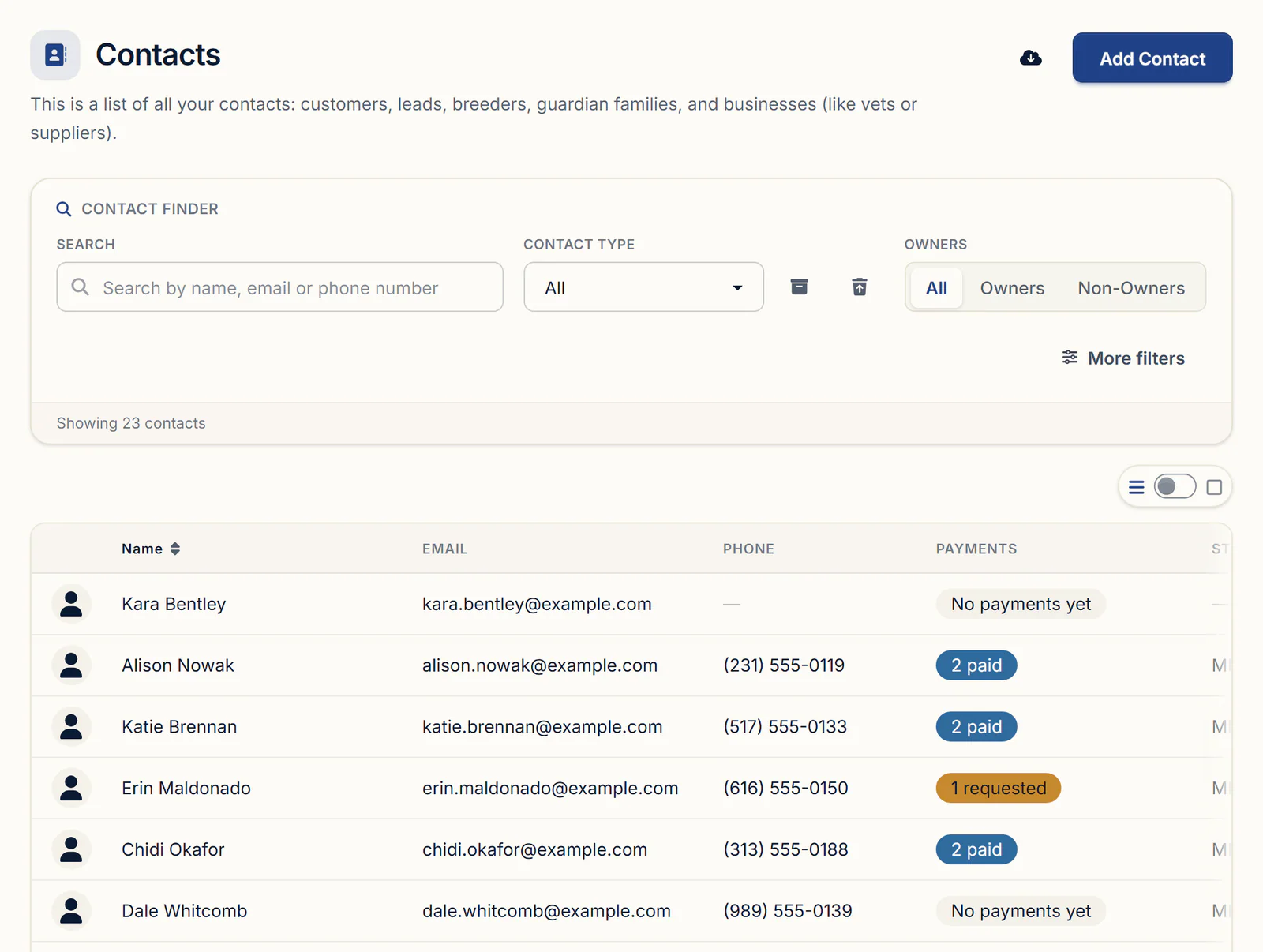
- Go to Contacts, click Add Contact, fill in First Name, Last Name and Email, set Contact Type to Guardian Family and click Save. Approving a guardian application instead? Convert into Contact lets you pick the type there.
- Open the dog's Relationships tab, click Assign Owner (on a puppy it says Reserve for a buyer), pick the family and click Save.
- On a puppy, BreederBuddy offers Retained instead of Reserved, because a guardian puppy stays in your program. Click Mark as Retained.
Set the type first: BreederBuddy reads it when you set the owner, to tell a guardian home from a sale. Keep an adult's Type as Active Breeding Dog so she stays on the Litter Planner.
To list every guardian family, pick Guardian Family under Contact type in the Contact Finder.
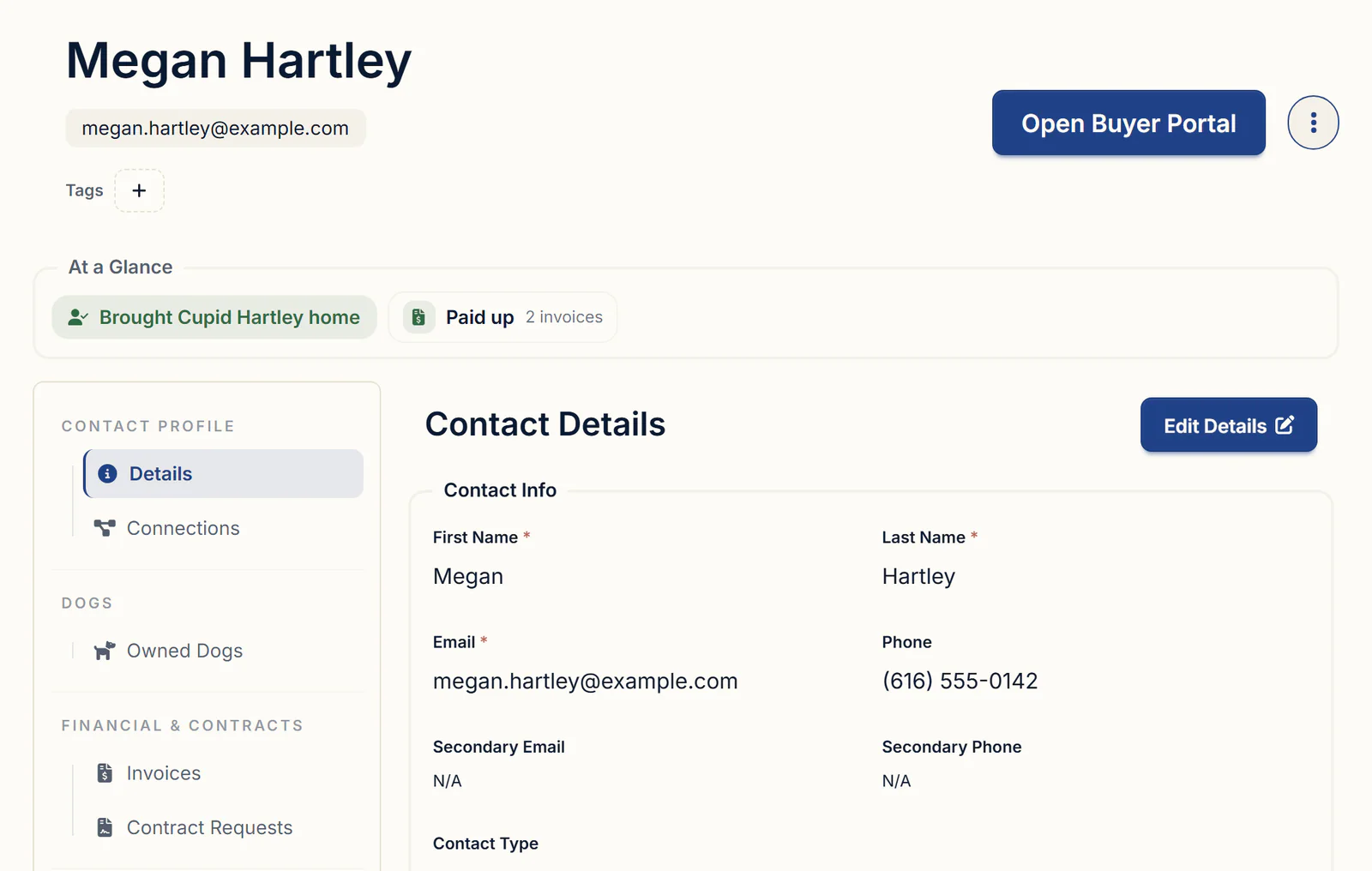
On the family's record, At a Glance reads Guardian home for and her name, and Owned Dogs lists her. On the litter's puppy list, a guardian puppy reads "Guardian home:" and the family's name.
Step 2: Send the Guardian Home Agreement
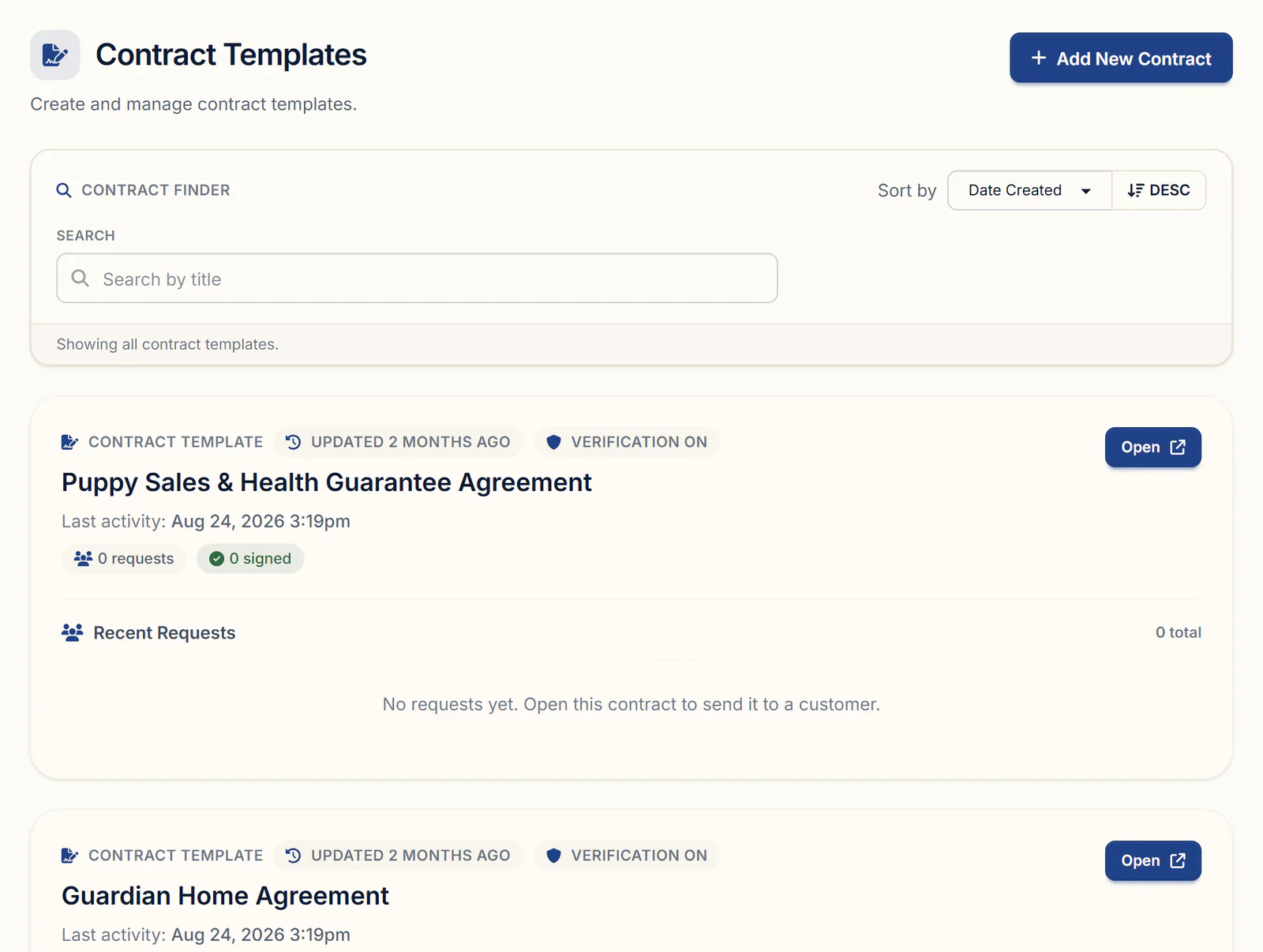
BreederBuddy's starter Guardian Home Agreement fills in your kennel, the family and the dog from your records, so you only edit the terms.
- Go to Contracts and click Add New Contract.
- On Guardian Home Agreement, click Use this template.
- Edit the Terms & Conditions. Replace "a maximum number of litters as agreed in writing" with your number, or a custom variable such as
${litter_limit}that BreederBuddy asks you for at each send. Add transport, relocation and buyout terms. - Check Dog Fields to Include (it starts with her name, date of birth, sex, breed, color, microchip and registration number), then click Save.
- Click Send Contract to Customer, choose the family and the dog, and send. If they aren't her owner yet, BreederBuddy asks Set Owner?.
Require email verification for this contract comes ticked, so the family enters a six-digit code from their email, types their name and signs by drawing or with the typed name, with no account or password. The signed PDF is saved on the template's Requests tab and on the family's Contract Requests. For a family still deciding, tick Send as a preview only (no signature required).
Step 3: Track her heats, breedings and return dates
Her heat history lives on her own record, wherever she is when a heat starts.
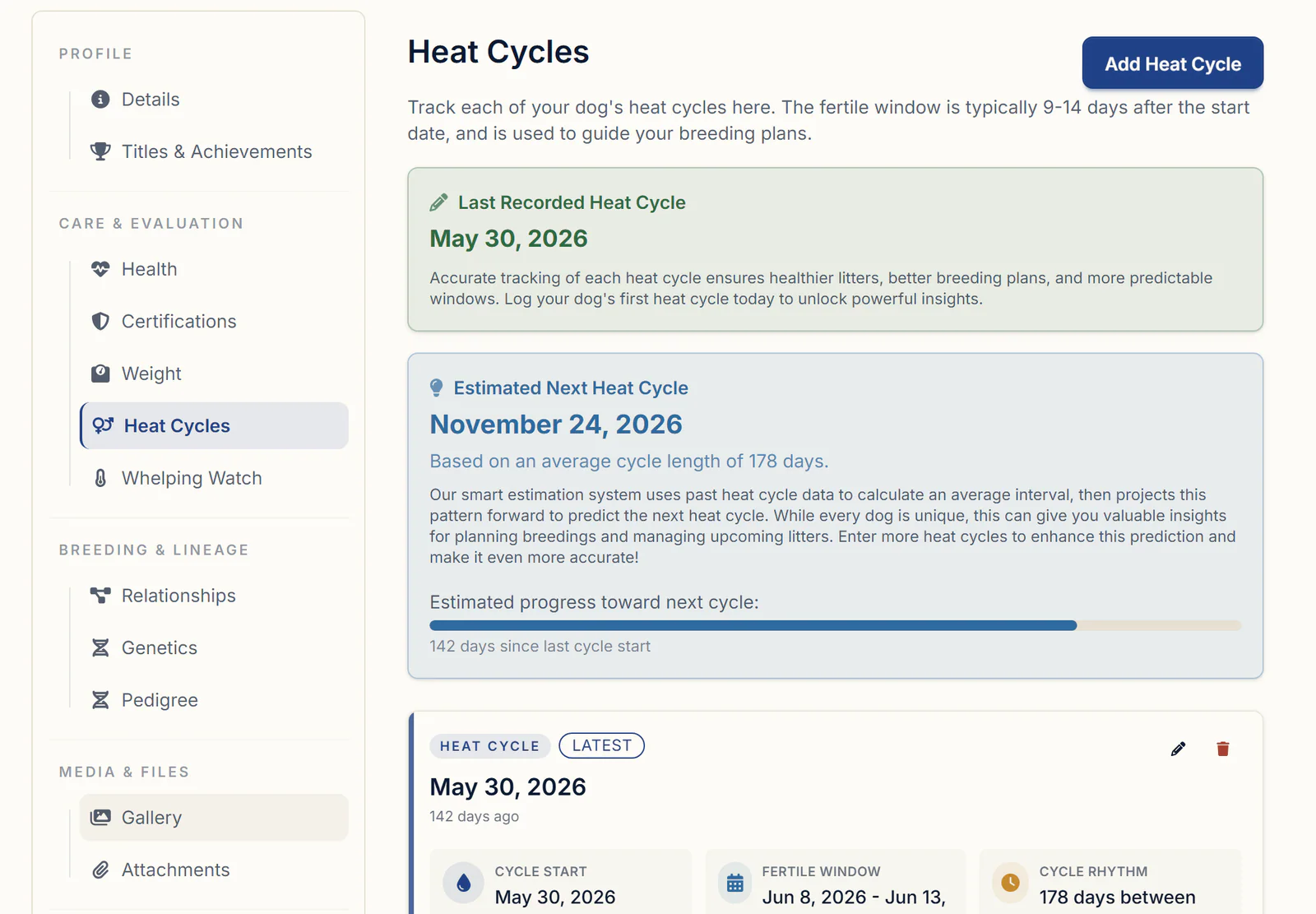
- When the family reports day one, open her profile, go to Heat Cycles and click Add Heat Cycle.
- Enter the Start Date. The fertile window defaults to days 9 to 14 after it; adjust the offsets if her history says otherwise, and click Save.
- For the heat you breed, expand the cycle's Cycle Activity to Log Progesterone Test and Log Breeding, then choose Create the litter to set her due date.
The tab shows her Estimated Next Heat Cycle, averaged from the gaps between logged heats (with one on file, it assumes about 180 days), and upcoming heats appear on your calendar as Est. Heat Cycle. So log every heat the family reports, not just the ones you breed. A guardian puppy gets the tab once her Type changes from Puppy to Active Breeding Dog. More in dog heat cycle tracking.
For drop-offs and pick-ups, click New Event on the Calendar, set Associate With to the dog and tick Email Reminder? to get an email up to a week ahead. It comes to you, not the family, so pass it on. The event shows on her Events tab, and Sync to Calendar adds it to your phone's calendar.
Step 4: Costs, the family's portal and retirement
The last pieces are what she costs, what the family sees, and the day she retires.
Costs. In Expenses, click Add expense, set Apply to to Dog, pick her, and log a drive's miles in Mileage (mi) on the line item. Her Finances tab totals what you've spent on her; the Expenses page totals your miles.
The family's portal. As her owner, the family sees her details and visible gallery photos under Your Dogs in their Buyer Portal, plus the agreement under Contracts. Send them the link from Open Buyer Portal on their record. Her health records stay private; to share one, add a copy to the family's Attachments with Buyer Portal set to Visible.
Retirement. After her last litter:
- Open her profile and click Edit Details.
- Set Type to Retired and, once she's spayed, Fertility to Spayed / Neutered. Click Save.
- Optionally, change the family's Contact Type to Customer, since she's theirs now.
She leaves the Litter Planner and moves to the Archived, Retired & Deceased section of your Dogs list, records intact. Transfer the registration through your registry.
What to look for in software for a guardian program
If you're comparing tools for a guardian program, check for:
- An owner field that names a family without calling it a sale
- A guardian contract you can edit, send and get signed online
- Heat cycles and breedings kept on the dog, wherever she sleeps
- Reminders for drop-offs and pick-ups
- Costs per dog, mileage included
- A private page where the family sees their dog and contract
Getting started
Everything in the steps above is on every plan, starting with Standard at $30/month or $300/year. Pro, at $60/month or $600/year, adds a kennel website built from your records, with Info Pages to explain your guardian program before families apply. Every plan has a 30-day free trial with no credit card required.
Questions
Who owns a guardian dog?
The breeder does, until the contract's terms are met. The family gives her a home and daily care, and the breeder keeps ownership, registration and breeding rights. Once her contracted litters are done and she's spayed, full ownership and registration pass to the family. In BreederBuddy the Owner field means the contact who has the dog, so you set the family there with the contact type Guardian Family, and her record reads as a guardian home rather than a sale.
Who pays the vet bills in a guardian home program?
Usually both, split by purpose. The common arrangement, and the one BreederBuddy's starter Guardian Home Agreement uses, is that the family pays for food, vaccinations and general vet care, and the breeder pays for health testing, breeding, pregnancy and whelping, plus the spay or neuter at the end. Spell out emergency care during a pregnancy, and who pays for the drives, in your own contract.
How many litters does a guardian dog have before she retires?
Whatever your contract says, which is why it should name a number instead of "as agreed". Set it with your vet based on the breed and her health, add an age she retires by, and check your registry's rules on a dam's age at breeding. BreederBuddy's starter agreement leaves the number for you to fill in.
What happens if a guardian family moves away?
Your contract decides, so write it in before she goes home. The usual choices are that the dog comes back to the breeder, that the family buys out the remaining litters at an agreed price, or that the breeder releases her early. BreederBuddy's starter agreement lets the breeder reclaim the dog if the family can no longer care for her or isn't caring for her as agreed, but it doesn't mention moving, so add a clause and have your attorney review it.
Can both partners in a guardian family sign the agreement?
Each contract request in BreederBuddy goes to one contact, who types their name and signs. If both partners should sign, add the second partner as their own contact and send the agreement to each of them. The dog's Owner field holds one of them, so when BreederBuddy asks Set Owner? on the second send, click No. If the second partner only needs a copy, put their address in the contact's Secondary Email instead: the contract email goes to both addresses, and one of them signs.
Is a guardian home the same as co-owning a dog?
No. In a guardian home the breeder owns the dog and the family keeps her as a pet. In a co-ownership, two parties share ownership under a co-ownership agreement, often with both names on the registration. In BreederBuddy, a co-owner is another breeder you invite to share full access to a dog's record, while a guardian family is a contact with the Guardian Family type who sees the dog in their Buyer Portal.
Terms used in this article
- Guardian home
- A family that keeps a breeder's breeding dog as their pet while the breeder keeps ownership and breeding rights under a written contract.
- Breeding rights
- The breeder's right, set by contract, to breed a dog or collect from a male for an agreed number of litters or period.
- Buyout
- An agreed payment that lets a guardian family end the breeding arrangement early and take full ownership of the dog.
- Progesterone testing
- Blood tests taken during heat that track rising progesterone to pinpoint ovulation and time the breeding.
- Ownership transfer
- Signing a dog's ownership and registration over to the guardian family once the contract's breeding terms are complete.
- Fertile window
- The days in a heat when a breeding is most likely to take, often estimated as days 9 to 14, though it varies by dog.
Sources
- OFA: Hip Dysplasiaofa.org
- OFA: Elbow Dysplasiaofa.org
In BreederBuddy
- Standard
- $30/month or $300/year. The full management platform: unlimited dogs, litters, and puppies, and multiple user accounts.
- Pro
- $60/month or $600/year. Everything in Standard, plus a template kennel website built from your records.
- Platforms
- Available on the web and as an Android app on Google Play (iPhone and iPad app coming soon).
- Free trial
- 30 days, full access, no credit card required.