
Coefficient of Inbreeding in Dogs: How COI Is Calculated From a Pedigree
By Kenny SchultzLast reviewed
The coefficient of inbreeding (COI) in dogs is the probability that a puppy's two copies of a gene at one locus both descend from the same copy in a shared ancestor. Each path through a common ancestor is worth 1/2 raised to the number of dogs on it, and the paths add up: full siblings give 25%, half siblings 12.5%.
Key takeaways
- Compare COIs only at the same pedigree depth: a 3-generation figure and an 8-generation figure for the same dog are different measurements.
- Treat a pedigree COI as a floor. Unknown ancestors count as unrelated, so recording more generations can raise it but never lowers it.
- Keep one record per dog. The same stud entered twice counts as two unrelated dogs and can make a linebred dog read 0%.
- Run the projected COI for every pairing you're considering and compare them, instead of judging one number against a fixed cutoff.
- Use COI alongside DNA health testing: two carriers of the same recessive can produce affected puppies at any COI.
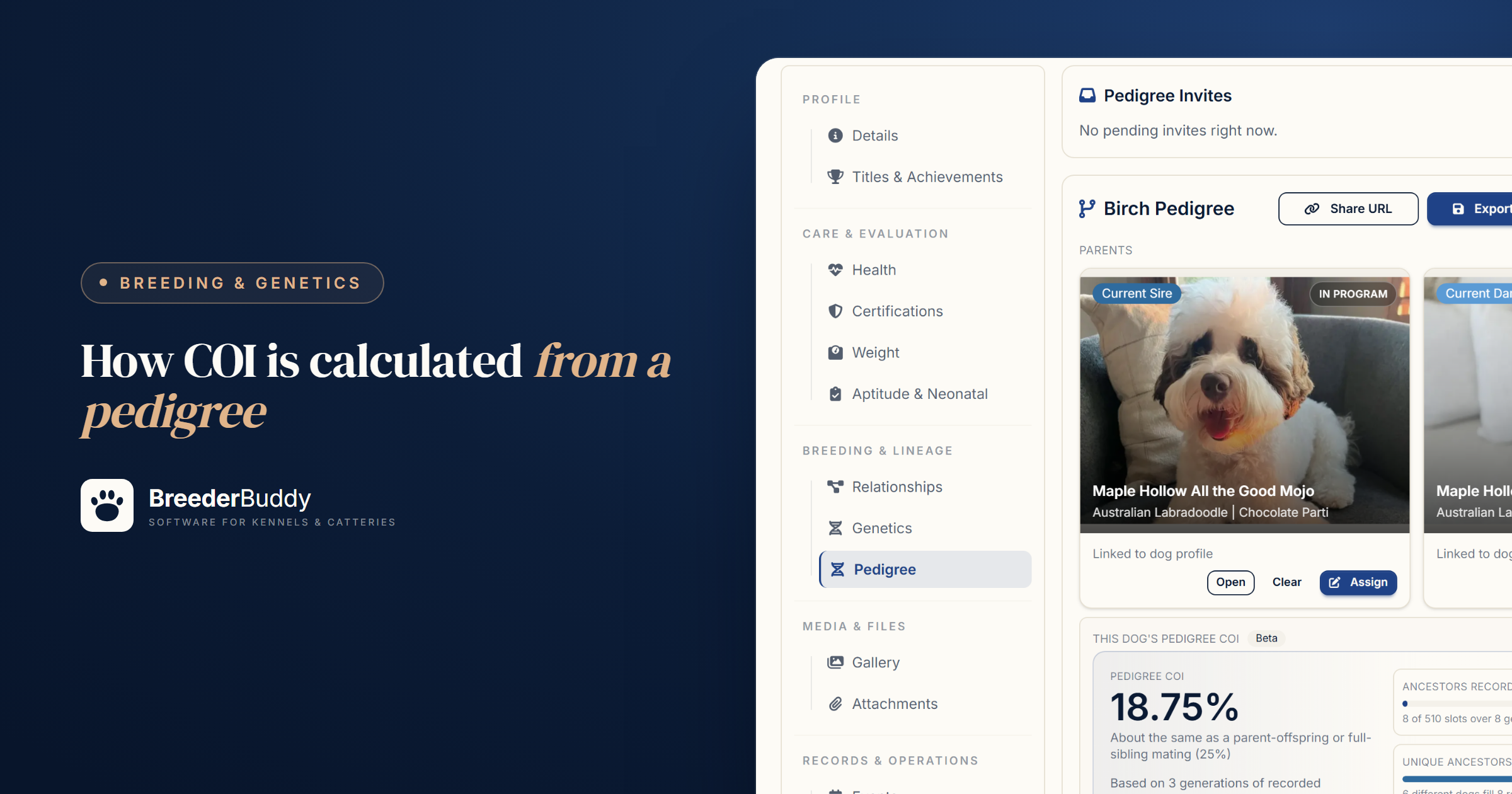
The coefficient of inbreeding (COI) in dogs is the probability that a puppy's two copies of a gene, at any one locus, are both copies of the same gene from a shared ancestor. You calculate it from the pedigree by tracing every path from the sire through a common ancestor to the dam: each path is worth one half multiplied by itself once for every dog on it, so a full-sibling mating comes to 25% and half siblings to 12.5%.
Below: where those numbers come from, why COI rises with more generations, how it differs from a DNA result, and how BreederBuddy calculates it for a dog or a planned pairing.
What the coefficient of inbreeding measures
COI measures how likely it is that a puppy inherited the same ancestral gene from both parents.
Every puppy gets one copy of each gene from its sire and one from its dam. When the two share an ancestor, that ancestor's gene can come down both sides and arrive twice. Geneticists call those two copies identical by descent. A COI of 25% means a one-in-four chance of that at any locus, so about a quarter of the puppy's genes are expected to be paired that way.
A recessive problem only shows when a puppy has two copies of the faulty gene, and carriers with one copy usually look normal. Breeding relatives raises the odds that two copies meet. The same doubling up works on the genes you want, which is how a linebred dog stamps his type on his puppies.
How to calculate COI from a pedigree
To calculate COI by hand, find the ancestors that appear on both sides of the pedigree and add up the paths through them.
- List the common ancestors: dogs that appear in both the sire's and the dam's pedigree. The sire himself counts if you breed him to his daughter.
- For each one, trace every path from the sire up to that ancestor and back down to the dam, never passing through the same dog twice.
- Count the dogs on the path, sire, dam and ancestor included. The path is worth one half multiplied by itself that many times: three dogs is 1/2 × 1/2 × 1/2 = 1/8, or 12.5%.
- If the common ancestor is inbred, multiply that path by 1 plus its own COI. An ancestor at 25% makes each of its paths count 1.25 times.
- Add the paths. The total is the puppies' COI.
Two things trip people up. It's the puppies' COI, not the parents': two heavily linebred dogs from unrelated lines can produce puppies at 0%. And skipping step 4 under-reports any pedigree whose common ancestor is inbred himself, which linebred lines often are.
COI for common matings
With no other shared ancestors, and no inbreeding in the common ancestors themselves, these matings give their puppies:
| Mating | Puppies' COI | How the paths add up |
|---|---|---|
| Parent and offspring | 25% | One path of 2 dogs: 1/4 |
| Full siblings | 25% | Two paths of 3 dogs: 1/8 + 1/8 |
| Half siblings | 12.5% | One path of 3 dogs: 1/8 |
| Grandparent and grandchild | 12.5% | One path of 3 dogs: 1/8 |
| First cousins | 6.25% | Two paths of 5 dogs: 1/32 + 1/32 |
| Second cousins | about 1.6% | Two paths of 7 dogs: 1/128 + 1/128 |
Every extra path adds, so half siblings whose shared sire is himself inbred, or whose dams are related, land above 12.5%.
Why the same dog can show different COIs
One dog can carry several COIs, because each depends on how much of the family it sees and how it was measured.
How many generations you record
A pedigree COI only counts the common ancestors it can see. Anything unrecorded counts as unrelated and not inbred, so recording more generations can raise it and never lowers it: every pedigree COI is a floor.
Ancestor slots double every generation back: three generations hold 14 in all, five hold 62 and eight hold 510. A shared ancestor five generations back is invisible to a three-generation pedigree.
Veterinary geneticists make the same point: a COI calculated over a few recent generations is limited in accuracy unless the pedigree reaches back to the breed's founders. So record as many generations as your paperwork supports, on both sides, and compare COIs only at the same depth.
Pedigree COI and DNA COI
A pedigree COI is an expectation built from recorded relationships. A genomic COI from a DNA panel estimates how much of the dog's actual DNA carries matching copies, so it catches inbreeding no pedigree reaches and usually runs higher.
Chance separates them too. Littermates share one pedigree COI, but each puppy inherits a different random half of each parent's DNA, so a DNA test can put them at different levels. A pedigree COI can project a litter from the parents' records before it exists; a DNA test measures the dog in front of you. Labs don't all calculate it the same way, so compare DNA results from the same lab and test.
Using COI to choose a pairing, and its limits
COI is most useful as a comparison between the pairings you're considering, projected before you breed and at the same pedigree depth.
- Compare options, not a cutoff. There's no single safe number: a figure that's routine in one breed would be high in another. Weigh a pairing against your other choices and what's typical for your breed.
- See what drives the number. If one ancestor accounts for most of it, ask whether his health and his offspring justify doubling him.
- Health test anyway. COI is an average across the whole genome. It can't tell you whether two dogs carry the same recessive, and two carriers can produce affected puppies at any COI. DNA health tests answer that for the conditions they cover.
The pedigree COI card in BreederBuddy
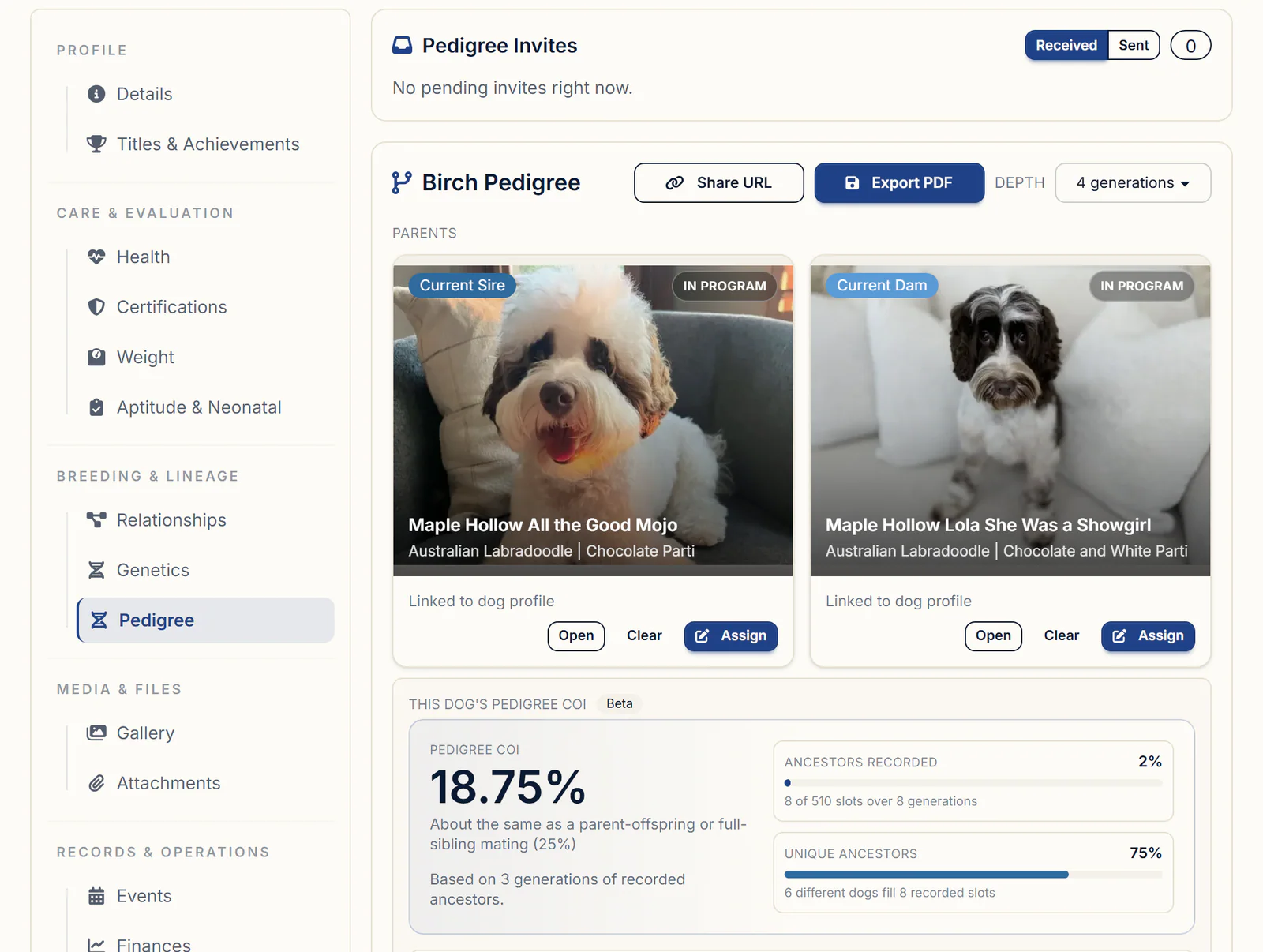
Every dog's Pedigree tab in BreederBuddy shows a This Dog's Pedigree COI card, calculated from the ancestors you've recorded, up to 8 generations deep.
- Go to Dogs, open the dog, and click Pedigree in the Breeding & Lineage group.
- Check the two Parents cards at the top: the COI card reads Not yet until both a sire and a dam are assigned.
- Read the card (marked Beta):
- Pedigree COI, with a line naming the nearest textbook mating, such as "About the same as a first-cousin mating (6.25%)".
- How many generations it rests on; with six or more, also the figure at 4, 6 and 8 generations, as far as your records reach.
- Ancestors recorded: how many of the 510 slots across 8 generations you've filled.
- Unique ancestors: how many different dogs fill those slots. 100% means no dog appears twice.
- Top Contributors, with each common ancestor's share, and warnings for empty slots, ancestors entered twice under the same name, and a parent recorded as born after its offspring.
The Depth dropdown only changes how much of the tree you see; the COI always uses the deepest pedigree available. A DNA-test COI recorded on the dog's Genetics tab sits beside the pedigree figure, never blended into it.
The puppy below shows the paths at work. Its sire and dam are half siblings by the same stud: one path of three dogs, 12.5%. The dam's dam is by that stud too, so a second path runs sire, stud, granddam, dam: four dogs, 6.25%. That makes 18.75%, exactly halfway between half and full siblings, and the card rounds up to the full-sibling line. With 3 generations and 8 of 510 slots recorded, the true figure may well be higher.
Filling in ancestors so the number holds up
The card is only as good as the records behind it: fill in ancestors and keep one record per dog.
- On a Parents card, click Assign and search by name or registration number. Your dogs and Outside dogs already in your pedigrees are listed together; click Select on the right one.
- Not listed? Add the dog as a new outside sire or dam. If it looks like one already on file (same name with or without titles, or the same registration number), BreederBuddy shows the match first: Use this one links it, and It's a different dog keeps them apart.
- Work further back in the tree: an empty slot shows Add Ancestor once the dog below it is recorded.
Have a paper pedigree? Import with Buddy on the dog's profile reads a photo or PDF of it and builds the tree for you to review; see importing breeding records from any file.
Puppies take their sire and dam from their litter, so build each parent's pedigree once and every puppy's Pedigree tab gets the whole family, and a COI.
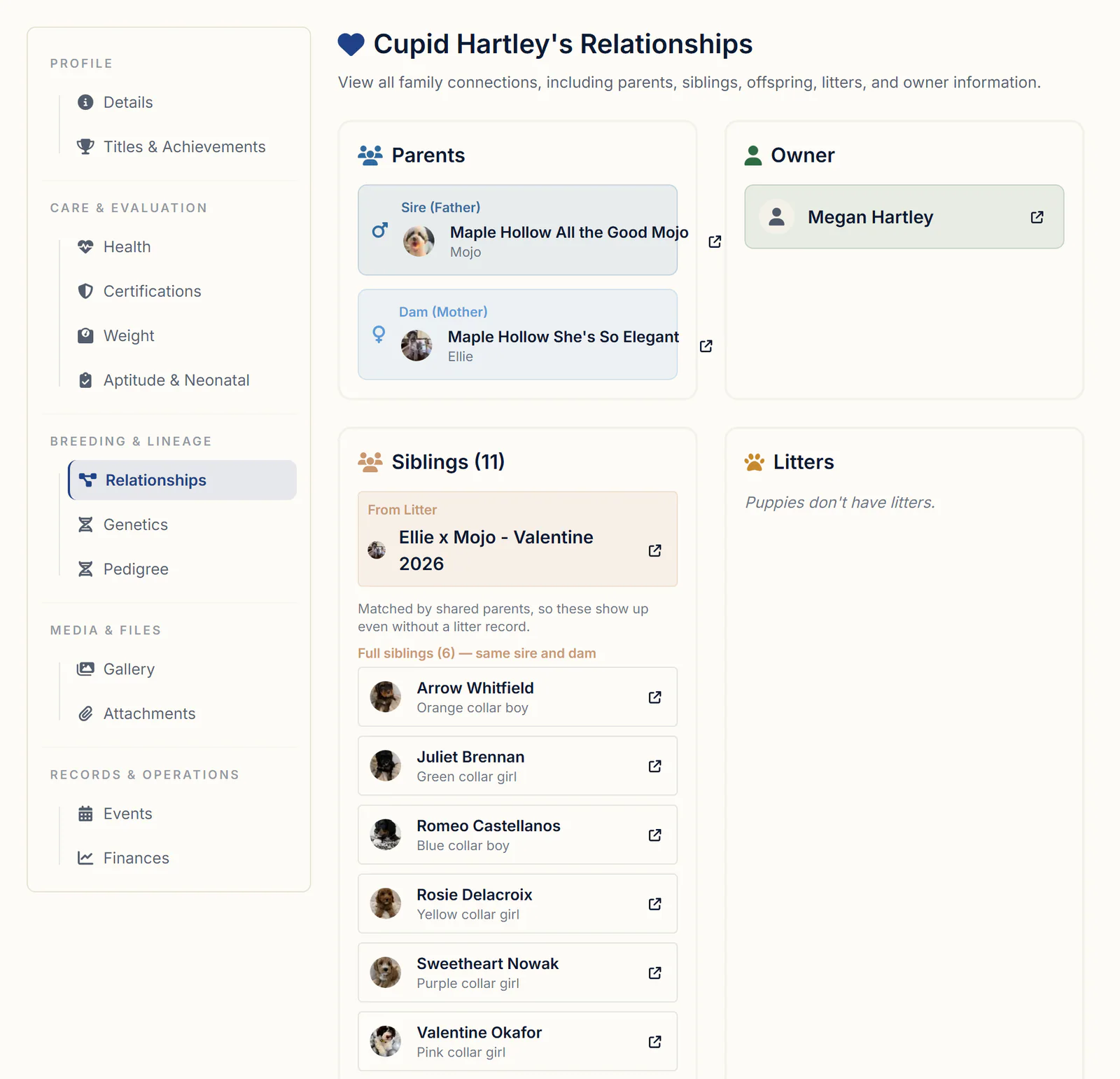
The COI card only flags copies with the same name, so a dog typed once with a title, or misspelled, can slip past it. To catch those, go to Dogs, click External pedigree catalog and open either copy: likely matches appear in a yellow box with a Merge button, and Merge with... finds one it missed. Keep one record and every pedigree that used the other switches to it. More pedigree tools are in dog pedigree software.
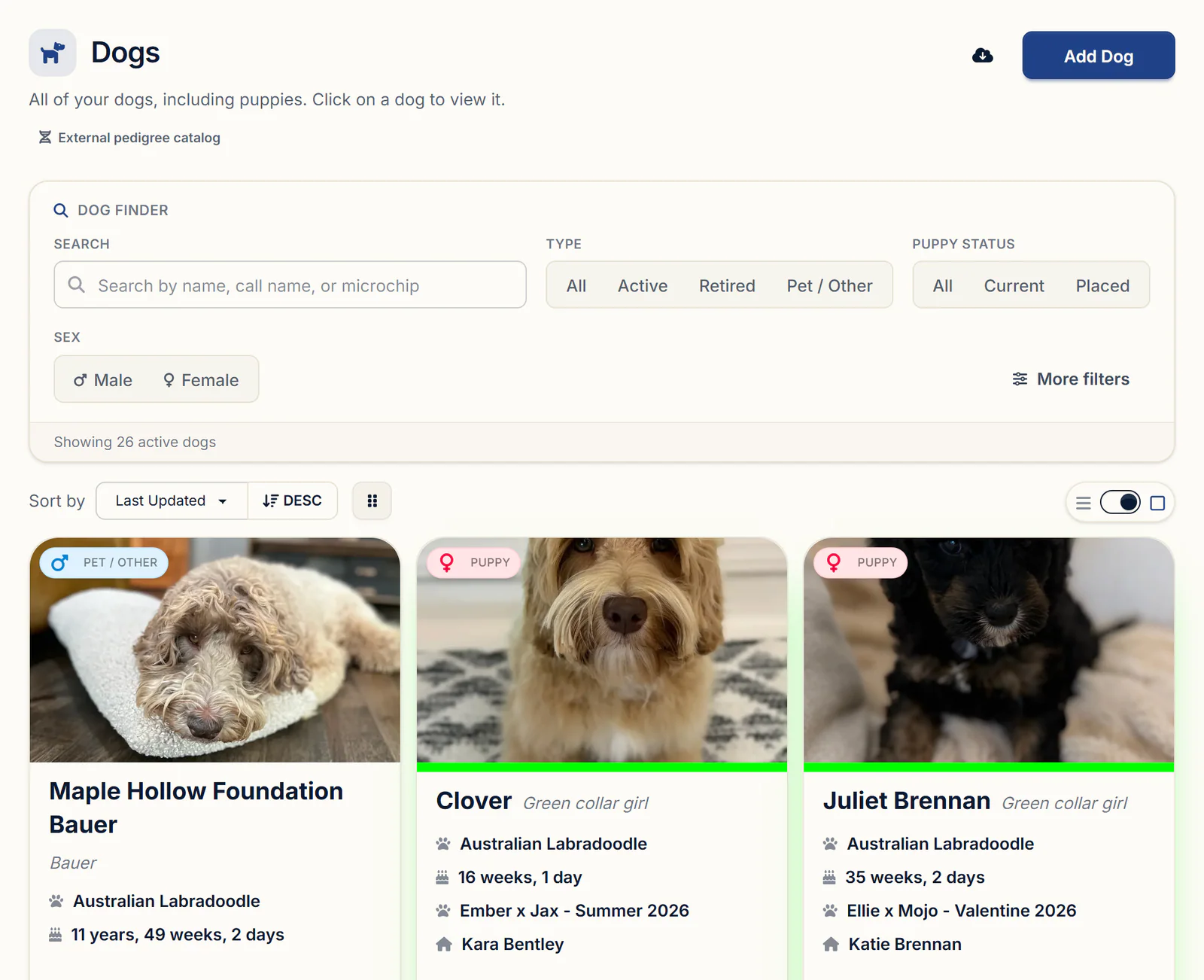
Projected offspring COI in Genetics Forecast
For a litter that doesn't exist yet, Genetics Forecast projects the puppies' COI from both parents' recorded pedigrees.
- Open Genetics Forecast under Tools & Analytics, or click Test Pairing with Dam (or Test Pairing with Sire) on a dog's Genetics tab.
- Under Sire and Dam, pick from My dogs, or switch to Outside dogs for a dog whose pedigree you've recorded but don't own, like an outside stud.
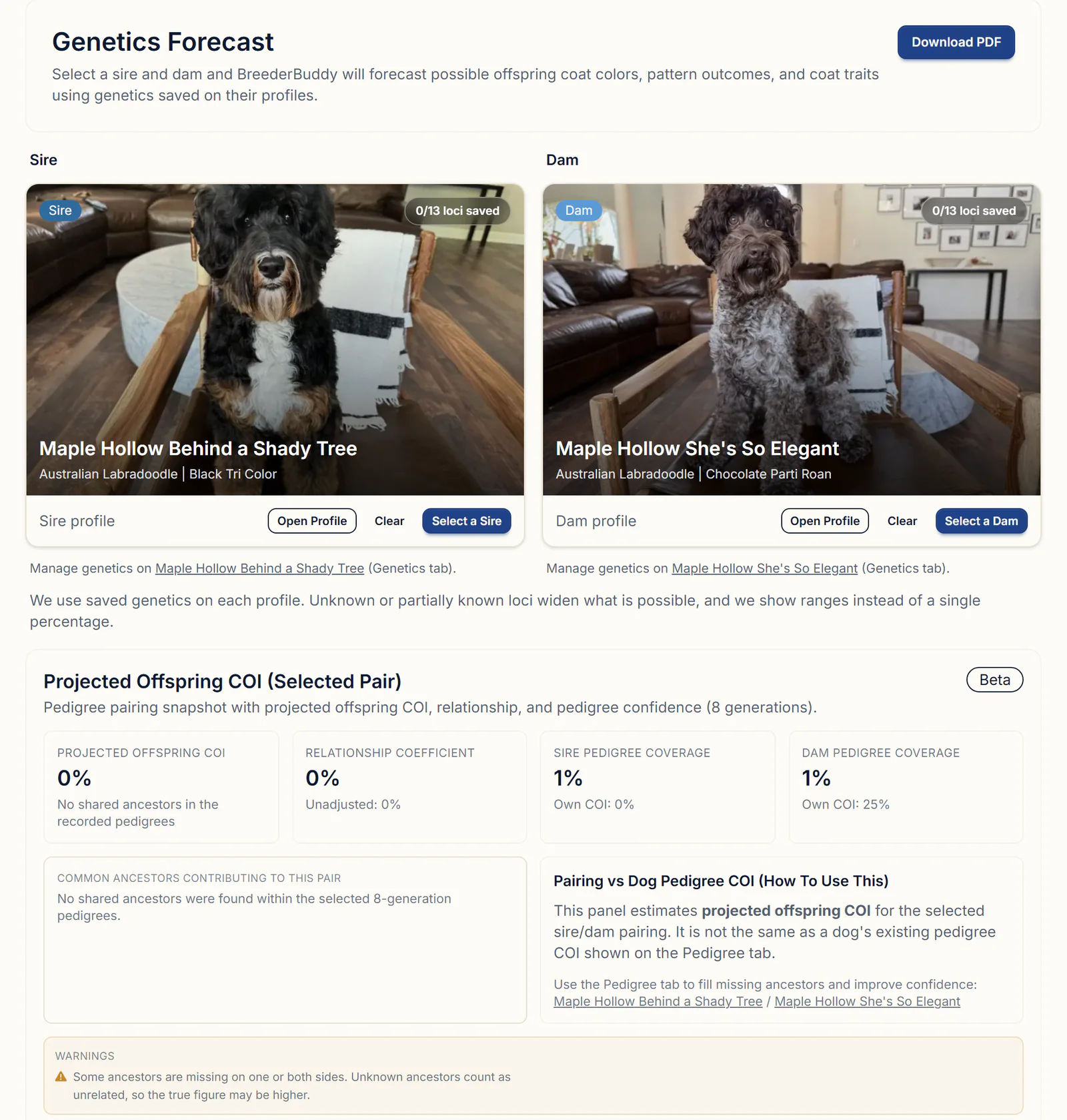
- Read the Projected Offspring COI (Selected Pair) card, marked Beta and based on 8 generations per side:
- Projected Offspring COI, with the same textbook line as the dog card.
- Relationship Coefficient: how closely the sire and dam are related. The unadjusted figure under it is twice the projected COI; the main one corrects for the parents' own inbreeding.
- Sire Pedigree Coverage and Dam Pedigree Coverage, each with that parent's Own COI.
- Common Ancestors Contributing to This Pair, with each one's share, plus warnings when ancestors are missing.
Here the dam's own COI is 25%, yet the puppies project at 0%: her inbreeding comes from her own related parents, and she shares no recorded ancestors with this sire.
Nothing is saved, so you can test every stud on your shortlist against one female. It also forecasts coat colors; see the Genetics Forecast walkthrough. Standing a stud? Save a visiting female as an outside dog, with her pedigree, and you can show her owner a projected COI before booking; more in stud dog management.
What to look for in a COI calculator
A good COI calculator shows its work. Hold any you're considering to this list:
- It includes each common ancestor's own inbreeding, not just a count of paths.
- It says how many generations the number rests on and that missing ancestors count as unrelated.
- It helps you find the same dog entered under two records, and merge them.
- It projects COI for a pairing you haven't bred, including outside dogs.
- It keeps a DNA-test COI separate from the pedigree figure.
Getting started
The pedigree COI card and Genetics Forecast are on every BreederBuddy plan. Standard is $30/month or $300/year. Pro is $60/month or $600/year and adds a kennel website built from your records. Every plan has a 30-day free trial with no credit card required. See the full set of genetics and pedigree tools.
Questions
Why does my linebred dog show a 0% COI?
There are two common causes. One is a shared ancestor entered twice, so the calculation counts two unrelated dogs. When the copies have the same name, BreederBuddy's COI card flags them and, if they're hiding inbreeding, shows the figure you'd get after merging. A copy typed with a title or a different spelling isn't flagged there, so check the External pedigree catalog on the Dogs page, where likely matches show with a Merge button. The other cause is a shallow pedigree: shared ancestors further back than you've recorded can't be counted.
What is a good COI for a litter of puppies?
There's no universal cutoff, and a number means little without its depth and breed. Compare the projected COI of each pairing you're considering, at the same number of generations, and against what's typical for your breed. When two pairings are otherwise equal, the lower COI means fewer genes are expected to arrive in duplicate. Health testing still matters at any number.
Why do COI calculators give different numbers for the same dog?
They're usually looking at different pedigrees. One may use five generations and another ten, one may hold ancestors the other is missing, or a dog may be entered twice. Some leave out a common ancestor's own inbreeding, which reads low whenever that ancestor is inbred himself. A DNA-test COI is a different measurement again and usually runs higher than a pedigree figure.
Is linebreeding the same as inbreeding?
Linebreeding is a mild form of inbreeding: you mate dogs that share an admired ancestor to keep more of that dog in the line. COI measures it exactly like any other inbreeding, so it shows how much inbreeding a particular linebreeding adds.
Does BreederBuddy have a free COI calculator?
There's no separate calculator to fill in. BreederBuddy calculates COI inside the app from the pedigree you record: each dog's Pedigree tab shows its own COI, and Genetics Forecast projects the COI for a sire and dam you pick, including outside dogs. Every plan has a 30-day free trial with no credit card required.
Terms used in this article
- Coefficient of inbreeding (COI)
- The probability that a dog's two copies of a gene at one locus are identical by descent, meaning both trace back to one copy in a shared ancestor.
- Identical by descent
- Two copies of a gene that are both inherited copies of the same gene in a common ancestor, not just copies that happen to match.
- Common ancestor
- A dog that appears on both the sire's side and the dam's side of a pedigree.
- Linebreeding
- A mild form of inbreeding that mates dogs related to one admired ancestor, keeping that dog in the pedigree several times.
- Coefficient of relationship
- How closely two dogs are related. When neither parent is inbred, their puppies' COI is half of it.
- Genomic COI
- An inbreeding figure from a DNA test, based on how much of the dog's actual DNA carries matching copies rather than on recorded ancestors.
Sources
- University of Missouri Extension: Inbreeding: Its Meaning, Uses and Effects on Farm Animalsextension.missouri.edu
- UC Davis Veterinary Genetics Laboratory: Genetic Heterogeneity and Diversity of North American Golden Retrieversvgl.ucdavis.edu
- Merck Veterinary Manual: Overview of Congenital and Inherited Anomalies in Animalsmerckvetmanual.com
In BreederBuddy
- Standard
- $30/month or $300/year. The full management platform: unlimited dogs, litters, and puppies, and multiple user accounts.
- Pro
- $60/month or $600/year. Everything in Standard, plus a template kennel website built from your records.
- Platforms
- Available on the web and as an Android app on Google Play (iPhone and iPad app coming soon).
- Free trial
- 30 days, full access, no credit card required.