
Dog Breeding Websites in 2026: What Actually Works (And Why Most Breeders Get It Wrong)
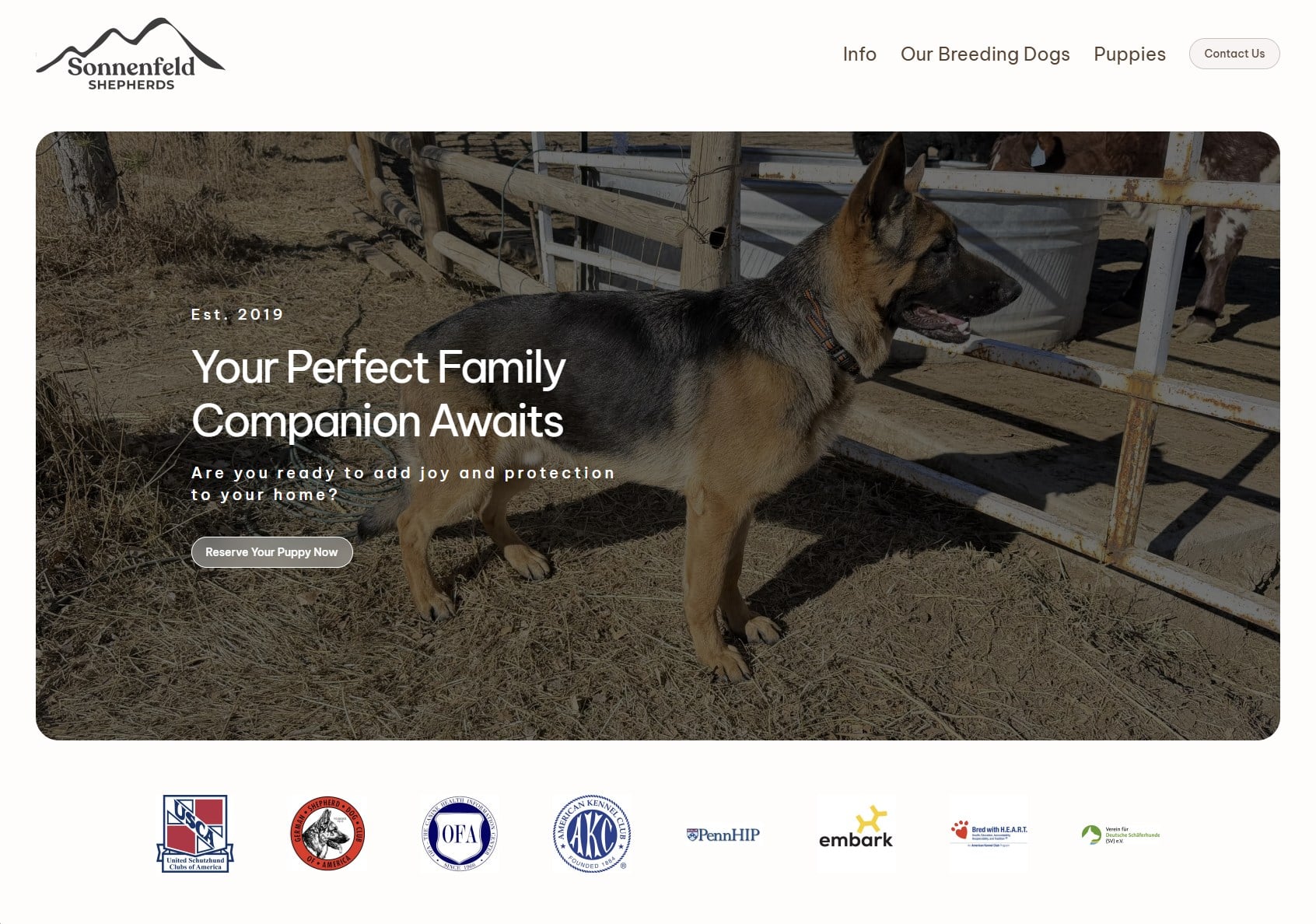
Spend ten minutes in any reputable breeder Facebook group and you’ll find the same debate playing out. Someone asks whether they really need a website. Half the replies say they’ve filled every litter for years with Facebook alone. The other half say their website is how serious buyers find them. Then someone who’s built both chimes in with the uncomfortable truth: they’re not competing strategies—and whichever one you’re relying on exclusively is probably costing you money.
Both camps are right, and that’s exactly why this topic is so confusing for breeders trying to grow. A strong Facebook presence genuinely does produce puppy inquiries. But a professional website does something Facebook can’t: it stays working for you at 2am when a puppy buyer in another state is searching for a breeder, and it’s what separates you from the sea of breeders who all look the same.
This guide breaks down what makes dog breeding websites actually work in 2026—why most breeders either skip them entirely or build something that hurts more than it helps, what buyers are really looking for, and the specific setup that converts a curious visitor into a committed inquiry.
Why Most Breeder Websites Don’t Work
Let’s deal with the skepticism head-on, because it’s grounded in real experience. Plenty of breeders have spent money on a website and gotten nothing from it. That almost never means websites don’t work for breeders. It means the website didn’t do its job.
There are three reasons breeder websites underperform, and none of them is “buyers don’t search online for breeders”:
The site wasn’t built to be found. A website that no one can find in Google is a digital brochure with the lights off. Without basic search engine optimization—the right keywords in the right places, a clear geographic signal, breed-specific pages—your site will never appear when someone searches “golden retriever breeder near me” or “AKC French bulldog puppies [your state].” Most template-based sites ship with none of this configured.
The site didn’t communicate trust fast enough. Puppy buyers are making a $1,000–$5,000+ decision from a stranger on the internet. They’re scared of scams. They’re comparing three breeders in a tab. If your website doesn’t immediately show them your health testing results, your kennel’s history, your dogs’ titles or certifications, and real photos of your actual dogs in the first 10 seconds—they’re gone. A generic template with stock photos does the opposite of build trust.
There was no clear next step. A website that just describes what you do without a visible, friction-free way to contact you—a waitlist form, an inquiry form, a calendar link—is missing the entire point. Interested buyers don’t call from a number buried in a footer. They click a button, fill a form, or move on.
Knowing this is the difference between spending money on a website once and abandoning it, versus having a site that quietly produces inquiries while you sleep.
The Demand Is Already There—You’re Just Not Capturing It
Here’s the part that every breeder should pay attention to. Puppy buyers are actively searching for you on Google right now. They’re not just posting in groups. They’re typing things like:
- “labrador retriever puppies [city] [state]”
- “health tested golden retriever breeder”
- “AKC registered dachshund puppies for sale”
- “reputable [breed] breeder near me”
These are high-intent searches. The person typing them has already decided they want a puppy. They’re in the research and vetting phase, and whoever shows up at the top of those results—with a professional, trustworthy site—has a massive advantage over the breeder whose Facebook page is the only thing Google can find.
The breeders who show up in those searches aren’t doing anything magical. They have a website that’s structured clearly, uses the right language, has individual pages for their breeds and their dogs, and updates regularly. That’s it.
What a High-Converting Breeder Website Actually Looks Like
The foundation isn’t design—it’s structure. Here’s what every effective breeder website has in common:
A Homepage That Answers Three Questions in 10 Seconds
Buyers decide fast. Your homepage needs to answer immediately: Who are you? What breed(s) do you raise? Are you legit?
That means a clear headline with your breed and location (“Health-Tested Labrador Retrievers in Central Texas”), a photo of your actual dogs (not stock photos), your health testing credentials or memberships front and center, and one obvious call to action—typically “Join the Waitlist” or “Inquire About a Puppy.”
Everything else is secondary.
Individual Pages for Every Breed You Raise
If you raise two breeds, you need two separate pages. Google ranks pages, not websites. A standalone page for “French Bulldog Puppies” that covers your health testing, your lines, your process, and your location is far more likely to rank for that term than a homepage that mentions it in passing.
This is the single highest-leverage SEO move available to breeders, and almost no one does it.
A Sires and Dams Page With Real Health Testing Results
Serious buyers research bloodlines. They want to see OFA scores, CERF/CAER clearances, genetic panel results, titles, and accomplishments. A dedicated page for your breeding dogs—with real photos, real names, and real health testing links—does three things at once: it builds trust, it gives Google more relevant content to index, and it pre-qualifies buyers who are serious about health.
A Transparent Process Page
“How does this work?” is the most common unasked question on any breeder website. Walk buyers through exactly what to expect: the inquiry form, your waitlist process, how you select families, your contract, your health guarantee, pick day, and your support after the puppy goes home. Breeders who write this out in detail close far more inquiries than those who say “contact us to learn more.”
A Simple, Low-Friction Inquiry System
The best inquiry systems for breeders are short forms—name, email, breed interested in, timeline, a few questions about their household. Long applications scare off buyers early; you can collect more detail later. The form should be visible on every page, not buried in a Contact tab.
The SEO Reality for Dog Breeding Websites in 2026
Search engines have gotten better at understanding what makes a breeder reputable, and that’s actually good news. They’re surfacing sites with clear health testing information, real content, and legitimate credentials—and filtering out the lowest-quality listing sites.
A few things that move the needle:
Location specificity matters. “German Shepherd breeder” is nearly impossible to rank for. “German Shepherd puppies in Knoxville Tennessee” is very achievable. Be specific about your location on every page that makes sense.
Fresh content still works. A litter announcement page, a recent blog post about your breed, a health testing update—Google rewards sites that update regularly. Monthly is enough.
Your Google Business Profile is free and underused. Set one up, verify it, add photos, and collect reviews from families who’ve taken puppies home. It’s the fastest path to appearing in local map results, and almost no breeders optimize it.
Backlinks from breed clubs and registries help. If you’re a member of a breed club or listed on a registry, ask for a link to your website from their member directory. These are among the highest-quality signals for breeder credibility.
The Website vs. Facebook Trap
This is where the two-camp argument breaks down. The breeders who rely only on Facebook have a fragile business. The algorithm changes, the account gets flagged, the reach collapses. Their entire pipeline evaporates.
The breeders who have only a website—but don’t show up in any of the communities where buyers are looking—miss the trust signals that come from seeing someone active, helpful, and respected in a breed group.
The answer is both, working together. Your website is the destination; Facebook and the breed groups are the channels that drive people to it. A buyer who sees you helping people in a Labrador group, clicks your profile, and lands on a professional website that immediately shows health testing, titles, and a real waitlist process—that buyer is already 80% of the way to an inquiry before you’ve said a word to them.
What to Do If You Don’t Have a Website Yet
If you’re starting from zero, the temptation is to grab the cheapest template you can find and call it done. Resist it. A site that looks amateur or breaks on mobile actively costs you credibility—buyers will close the tab and move to the next breeder.
You don’t need a $10,000 custom site. You need something that:
- Loads fast on mobile (over half of puppy buyer searches happen on a phone)
- Has a clean, professional design that reflects the quality of your program
- Has the pages listed above—homepage, breed pages, dogs pages, process, contact
- Is optimized for the basic SEO signals: title tags, breed + location keywords, clean URLs
Tools built for breeders have come a long way. The best ones now include SEO features, litter management, inquiry forms, and waitlist tools—all without needing to hire a web developer for every change you want to make.
The Bottom Line
The breeders who dismiss websites aren’t wrong that Facebook works. They’re wrong that Facebook is enough. Your health testing records, your dogs’ titles, your waitlist, your process, your five-star reviews—none of that lives anywhere permanent on Facebook. It disappears into the feed.
A website is the one place where everything that makes your program credible exists in one place, 24/7, findable by people actively looking for exactly what you offer.
Get the structure right. Put your real dogs and real credentials front and center. Make it easy to inquire. Optimize for your breed and your location. Do that, and the question stops being “do I really need a website?” It becomes “why didn’t I build one sooner?”
BreederBuddy is an all-in-one platform built for dog breeders—including a professional website builder, litter management, waitlist tools, and SEO-ready templates. Start your free trial today.